AI Search Demands New Ways of Working
The evolution of search through AI is shifting how digital marketing teams operate. So how should your teams be working in this new environment?

Historically, the relationship between paid and organic teams was often collaborative but distinct. Those teams then interacted with product and website dev teams. However, the rise of Large Language Models (LLMs) and AI-driven discovery suggests that this bounded-team model is no longer sufficient. To truly capture how a brand is perceived and surfaced by AI, a more holistic approach is required—one that integrates customer service, branding, web development, and technical feeds.
Moving Beyond the Traditional Split
At Kinase, we have found that AI search necessitates a more integrated workflow. Because LLMs process information from a vast array of sources, relying on a narrow view of search data can lead to missed opportunities. Instead, we have established ways of working that prioritize a quick, impactful feedback loop across multiple departments.
Rather than viewing paid and organic as separate silos, we look at how they can provide actionable data to one another in real time. This integration doesn't just stop at search teams; it extends to the technical and service-oriented parts of the business.
Turning Paid Insights into Organic Strategy
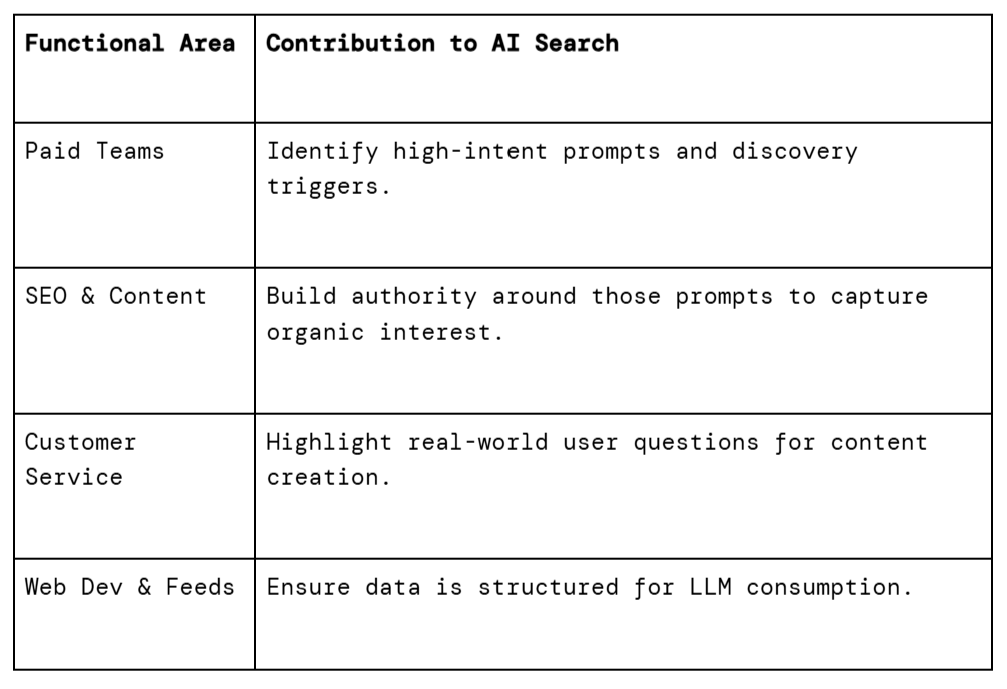
One of the most immediate benefits of this integrated model is the ability to share discovery data. Paid AI campaigns often surface specific prompts and discovery phrases that resonate with users. In a traditional setup, this data might stay within the paid team.
In a more modern, unified workflow:
SEO teams can take these high-performing phrases to build out targeted content and technical optimizations.
Web development and feed management teams ensure the technical infrastructure allows AI to crawl and understand this content efficiently.
Branding ensures the tone and messaging remain consistent as the brand is surfaced across different AI platforms.
The Role of Customer Insights
The feedback loop also benefits significantly from involving customer service teams. The questions and friction points surfaced in customer service logs or AI chat windows are a direct window into user intent.
When content is designed to answer these specific product questions, it does more than just help the customer; it signals authority to AI search engines. This helps surface the brand in AI chat results, bringing potential customers closer to conversion more quickly. The result is often an increase in revenue per click. Users who are better informed and more likely to take action when they reach the site.
Budgetary Shifts and Future Outlook
While it is still early days for AI-enabled search, we are already seeing how the interconnectedness of these channels influences investment. The synergy between paid visibility and organic authority has led to increased spend in AI-driven campaigns.
Ultimately, the goal is to move away from partial views of a brand’s digital footprint. By integrating these various teams, businesses can create a more cohesive presence that aligns with how AI actually discovers and recommends information today.
Is your current team structure allowing for this kind of cross-functional data sharing?