Google Marketing Live 2026: The AI Stack Matures for Performance
James Monaghan reports back from Dublin where Google unveiled their new marketing tech across search, YouTube, commerce and measurement
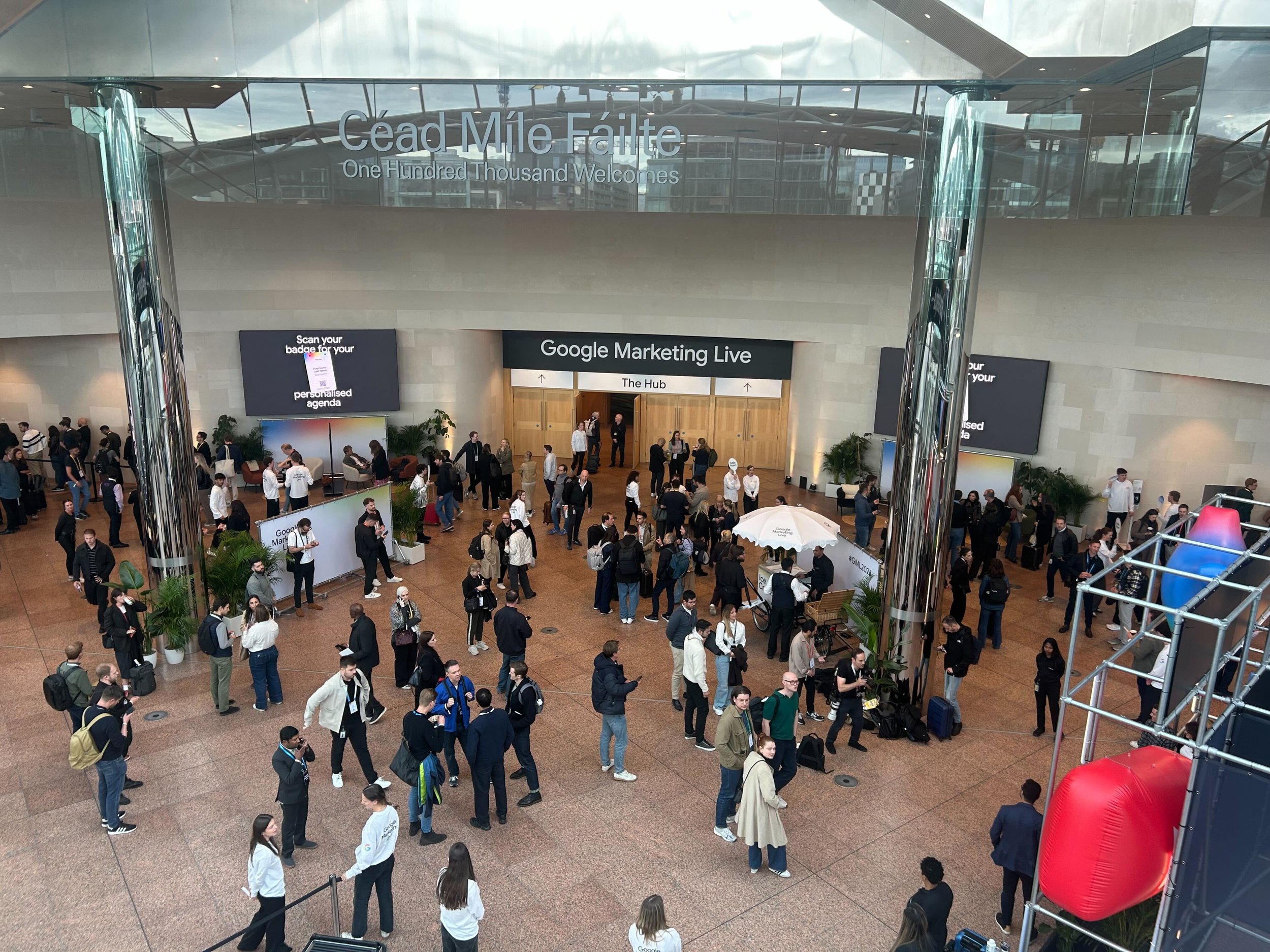
Last year’s Google Marketing Live (GML) felt like a gallery of new ad tech—impressive in their speed of development, but decidedly experimental. This year marked a distinct shift. The narrative has moved away from theoretical AI capabilities toward a cohesive, matured ecosystem ready for immediate practical application.
Here is my break down of the core shifts from GML 2026 and how Kinase is approaching them.
1. Intentional AI
As Google transitions platform optimization fully to an agentic model, the nature of a marketer’s day-to-day work is evolving. Two features stand out as the new touchpoints for campaign steering:
AI Briefs: Advertisers will be able to use natural language to set explicit brand guidelines, audience rules, and voice boundaries for AI generated ad assets. This will replace the combination of settings and ad copy line pinning which currently exists, while preserving absolute control of messaging in the case of advertisers who need to display terms and conditions, for example when working with financial regulators. AI Briefs act as a direct training chat, allowing the AI to dynamically generate assets that remain strictly on-brand.
Ask Advisor: This introduces an agentic function directly within Google Ads. It allows for robust conversational testing and deeper interrogation of platform mechanics, signalling the end of manual execution as a primary skill set.
2. The Evolution of the Commerce Funnel
The purchase journey is changing its shape. Single-day shopping events are becoming more complex, while longer-term consideration phases are shrinking. Google is addressing this friction by turning product feeds into what they term a "virtual storefront".
Connected Cart
Through the Universal Commerce Protocol (UCP), Google is merging native checkout directly with its AI mode. This enables persistent, cross-surface ‘intelligent’ shopping carts that follow users from YouTube to Search and Gmail , backed by integrated Buy-Now-Pay-Later (BNPL) options and direct links to Google Wallet. Enhanced cart data, including stock alerts and price monitoring, will roll out in the USA in Summer 2026.
Direct and Customised Offers
"Direct Offers" available for AI to surface in Google AI Mode are not just blanket discounts, but can be highly tailored, one-time-use coupon codes and localised incentives.
To capture this automated demand, optimizing your underlying feed health is non-negotiable. Advertisers must leverage tools like the Merchant Excellence Report and lean fully into AI Max formats to ensure they are visible in intelligent search and shopping spaces.
3. Creative Performance Without Compromise
Creative remains a primary lever for performance. The updates this year focus on scaling this impact without losing precision:
The big reveal was in Asset Studio. Marketers can now create and then bring to life a storyboard directly into a video asset, complete with automated A/B testing out of the box. This allows brands to scale creative variations programmatically, matching the velocity that automated campaign formats require.
Links with popular and powerful tools such as Canva and Adobe suite were announced, showing how Google are serious about making their ad stack part of a real creative workflow.
4. Advanced Measurement and Causal ROI
With Gemini poised to alter search behaviour, demonstrating true return on investment requires a sophisticated data infrastructure.
Google's updated data framework focuses on moving closer to a unified view of performance and real value generation.
The core is an upgrade to Google’s analytics offering, combined with predictive conversions. Incrementality testing via Attributed Brand Searches (ABS) is scaling up to predict "Qualified Future Conversions," using AI to project customer signals 1 to 6 months into the future. Additionally, Google Analytics 360 will soon integrate Meridian (Marketing Mix Modelling functionality), bringing natural language querying capabilities to enterprise analytics.
5. Journey-Aware Bidding and Smarter Lead Gen
Bidding algorithms are becoming more patient and context-aware. The upcoming rollout of Journey-Aware tROAS and tCPA means algorithms can now account for the actual length and complexity of a user’s path to purchase, removing rigid time windows for conversion events.
For Lead Generation Advertisers:
The infrastructure for lead quality is receiving a much-needed overhaul:
Data Routing: Enhanced Conversions for Leads (EC4L) now flows seamlessly from Salesforce into Search Ads 360.
Algorithmic Cleaning: The new "Advertiser Identified Invalid Leads" feature allows businesses to pass low-quality or fake leads back into the algorithm, actively training the system to avoid poor targeting in the future.
The Business Agent: Local AI business agents are launching (highly applicable to sectors like Real Estate), allowing users to get answers and convert without ever visiting a traditional website.
The Kinase View
The overarching theme of GML 2026 is that the "how" of platform execution is being handled by Google's core AI stack. The competitive advantage has shifted to the "what"—what data you give it, what brand guardrails you establish, and how you define your unique selling proposition.
Ensuring your business is ready for this intelligent, agentic search ecosystem is something Kinase is already leading on. If you are looking to move your Google Ads strategy from fragmented testing into a matured, AI-driven performance engine, let’s start a conversation.
